Add a coin
Your coins
The foundation
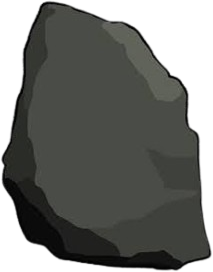
Compounding is the oldest idea in finance. The Ether Rock wants to be your foundation for it.
A rock does nothing on its own. What makes this one different is that every trade of it charges a 3% transfer tax and pays that tax straight to the people holding it — and your cut is strictly proportional to how much you hold. Which means the payout can buy more of the thing that earns the payout. That loop is the whole of compound interest, and people have been chasing it for four thousand years.
- c. 2000 BCBabylonian scribes work compound-interest problems on clay tablets — how long a loan at 20% takes to double. Interest on interest is older than the alphabet.
- 1494Luca Pacioli's Summa de Arithmetica circulates the Rule of 72: divide 72 by the rate and you have the years to double.
- 1613Richard Witt publishes Arithmeticall Questions, the first book devoted entirely to compound interest — tables built by hand, at a time when the Church still called the practice usury.
- 1683Jacob Bernoulli asks what happens if you compound not yearly but constantly. The answer is the number e — 2.71828… — discovered inside a question about interest.
- 1790Benjamin Franklin leaves £1,000 each to Boston and Philadelphia on one condition: let it compound for two centuries. By 1990 Boston's share was worth roughly $5 million. He called it his experiment.
The reason it keeps reappearing is that growth on growth is not a bigger line — it is a different shape. Money left to compound doubles on a schedule set only by its rate:
| Rate per year | Years to double (72 ÷ rate) |
|---|---|
| 5% | 14.4 |
| 10% | 7.2 |
| 20% | 3.6 |
| 50% | 1.4 |
And crucially, how often you reinvest changes the outcome, not just how much. That is Bernoulli's point: the same nominal rate compounds to more the more frequently it is rolled back in. A reward that sits in your wallet as a different asset is earning you nothing — it has stepped out of the loop.
Which is all this service does. Your ROCK pays you in WETH; WETH does not earn ROCK rewards; so the keeper turns it back into ROCK, your share of the next payout is larger, and the loop closes. It only acts when the round trip is actually worth paying for — see the cost gate above.
How this works
A StonkFun reward coin charges a transfer tax on every trade and pays it to holders — denominated in the asset it is paired against, not in the coin itself. So the payout you receive is a stock token, and holding it does nothing for your position. Compounding swaps it back into the coin, which raises your pro-rata share of every future payout.
To act while you are away, the keeper needs a signing authority. You grant a bounded SPL delegate on the single token account your rewards land in. That lets it spend up to the allowance from that account only — it cannot touch your coin balance, your SOL, or any other token, and you can revoke it at any time. Size the allowance to a few weeks of expected payouts rather than to a balance: the allowance is the amount at risk.
Payouts are usually worth cents, while a swap costs pool fees, price impact and the coin's own transfer tax. Compounding every payout would lose money, so income is banked and only reinvested once the round trip is worth it. Each coin below shows what it is waiting for.